Nasdaq Wipes Out 2026 Gains as AI Stocks Lead Wall Street Selloff
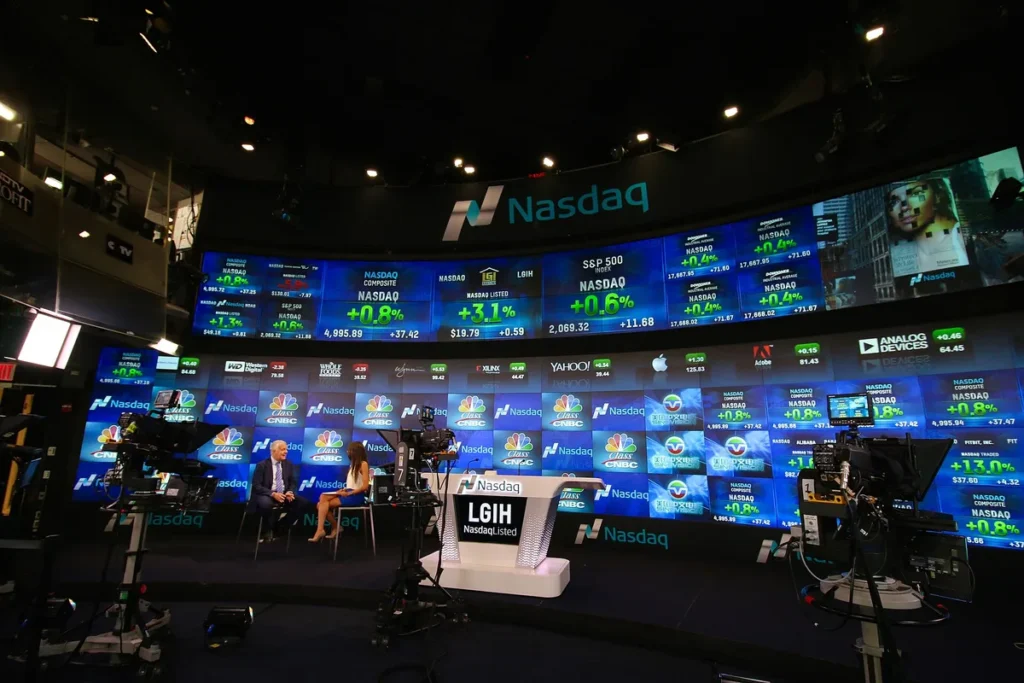
Wall Street’s technology selloff turned into a rout on Friday, November 20, and the Nasdaq wiped out its 2026 gains in a single brutal session. The Nasdaq Composite fell 5.28 percent on Friday to close at 22,617.73, below its level at the end of last year of 23,241.99, erasing all of its gains for 2026. The S&P 500 dropped 3.7 percent and the Dow Jones Industrial Average fell 1.93 percent, with both indexes entering correction territory after falling at least 10 percent from their recent record highs. The selloff capped the Nasdaq’s worst week since the pandemic and wiped about $6 trillion off the value of US stocks in the 45 days since the leading indexes reached record highs on October 6. What began as doubts about artificial intelligence spending has become a full test of whether the AI boom can justify the trillions poured into it.
Table of Contents
Nasdaq Wipes Out 2026 Gains: The Friday Numbers
Friday’s losses were broad and steep. The Nasdaq’s 5.28 percent drop was its worst single session of the selloff, and the S&P 500’s 3.7 percent fall put it on track for its seventh consecutive day of losses, its longest losing streak since February 2020. The S&P 500 had already fallen below its 200-day moving average on Tuesday, a level often seen as a cushion for long-term trends, and broke through it again on Thursday. According to Wharton finance professor Jeremy Siegel, that technical break turned many investors, including commodity trading advisers, into automatic sellers, which deepened the decline. NDTV Profit listed the broken 200-day average among the five factors behind the selloff.
The damage went beyond the headline indexes. The Nasdaq-100, which tracks the largest non-financial companies on the exchange, fell 5.6 percent on Friday and approached a bear market after losing nearly 20 percent from its recent high. Chipmakers led the fall: Nvidia lost 14.10 percent, Broadcom fell 13.11 percent, AMD dropped 14.00 percent and Micron fell 14.17 percent. Taiwan Semiconductor, listed in the United States as an American depositary receipt, fell 9.48 percent, and SK hynix dropped 13.97 percent. The selling was not limited to chips. Technology heavyweights and cloud infrastructure providers, including Amazon and Microsoft, were also under pressure as investors questioned the returns on AI spending.
The fear gauge told the same story. The VIX, Wall Street’s measure of expected volatility, climbed to 32 this week, its highest level in 19 months, according to NBC Palm Springs. A reading above 20 generally signals heightened investor uncertainty, and 32 reflects real fear. Investors moved toward traditionally safer investments, including US Treasury bonds and defensive sectors such as healthcare and consumer staples. The shift in sentiment was stark: barely six weeks after the Nasdaq hit a record high, the index was down for the year, and the S&P 500 had given back much of its 2026 advance.
Nvidia Leads the Fall as Scandals Pile Up
Nvidia, the company at the center of the AI boom, has been hit hardest of all. Its shares fell more than 16 percent during the week, and the company has lost more than 40 percent of its market value since its October 6 peak, shedding approximately $2.5 trillion in value. Friday’s roughly 14 percent decline marked its worst session in almost two years. Three weeks ago, Nvidia was the largest company in the world. Now it is the symbol of a trade that has cracked.
The troubles began on October 29, when an international spy-affair saga involving Nvidia’s former chief executive Jensen Huang broke suddenly and threw the company into turmoil. Three weeks later, the shares had eroded deeply, dragging the Nasdaq into correction territory. The latest blow came from a Reuters report that the company was under investigation by the Securities and Exchange Commission over accounting gaps. Why exactly the investigation was opened has yet to be established, but the report added to a pile of scandals haunting the chipmaker at the worst possible moment.
Huang’s troubles have spilled into politics as well. He has agreed to testify before the US Senate, a development that keeps the company in the headlines for reasons that have nothing to do with its products. Nvidia released excellent results and an upbeat forecast on Tuesday, but that did little to support its shares. The market’s message is blunt: strong earnings are no longer enough when investors doubt the leadership, the accounting and the sustainability of the AI spending boom itself. For more on how crypto markets reacted to the same risk-off mood, read our report on the Bitcoin price crash.
Anthropic’s IPO Turns From Triumph to Warning

Even the most anticipated market event of the year could not stop the slide. Anthropic, the developer of the Claude artificial intelligence model, went public on Thursday in a blockbuster debut, with shares opening at $111.50, up 34 percent from the initial public offering price of $83. Demand far exceeded supply, and the stock surged at the start of trading. It was the kind of debut that normally revives a market. Instead, it became a selling opportunity.
On Friday, Anthropic shares plunged. The stock fell as low as $83.05 at one point, approaching its IPO price, before closing down 8.50 percent at $88.91. The company’s market value shrank by $109 billion in a single day to $1.1753 trillion, and its ranking slipped to 12th from 10th among the largest US companies. The stock fell a further 1.26 percent in after-hours trading to $87.79. Analysts offered a mixed assessment: Seaport Research called Anthropic an “incredible company” but cautioned that its valuation demands an equally significant leap of faith from investors, and assigned a neutral rating while flagging concerns about revenue growth.
The IPO’s reversal captures the mood shift. Just a day earlier, Anthropic’s debut was celebrated as proof that the AI boom still had momentum. Within 24 hours, investors were using the debut to take profits on the artificial intelligence rally rather than to buy into it. The success of the listing turned into a double-edged sword: it showed there is still demand for AI companies, but it also gave worried investors a liquid, high-profile stock to sell. Our report on the Riemann Hypothesis proof claim covers Anthropic’s other big story of the week, the mathematician’s claim that its Claude model solved math’s greatest problem.
Why Investors Are Selling: Five Forces Behind the Rout
The selloff has no single cause. Instead, a collection of fears has built up one after another over the past six weeks, compounding into a rout. The first is the simplest: the cost of the AI boom. Companies are spending hundreds of billions of dollars on data centers, computer chips and other infrastructure, and investors are increasingly demanding evidence that those investments will generate sufficient returns. The latest losses reflect growing concerns about whether the massive spending will ultimately pay off, and whether the valuations built on AI growth were ever justified.
The second force is Nvidia itself. As the flagship of the AI revolution, its scandals have shaken confidence in the whole trade. The spy-affair saga, the reported SEC investigation and the Senate testimony have turned the market’s biggest winner into its biggest source of uncertainty. When the flagship stumbles, the companies around it fall too: CoreWeave, a cloud computing company backed by Nvidia, dropped 10 percent on Friday.
The third force is inflation and the Federal Reserve. Costs for goods and services rose more than expected in October, with the consumer price index rising 0.4 percent for the month according to Bureau of Labor Statistics data. That was a fresh warning sign for the Fed in its fight to lower inflation. The central bank had skipped one rate hike after its September revision, but experts are now factoring in a higher increase to catch up. Higher rates for longer would raise borrowing costs for the companies funding the AI buildout, and would make their future earnings worth less today.
The fourth force is technical selling. Once the S&P 500 broke its 200-day moving average, computer-driven funds began selling automatically. Bloomberg reported, citing estimates from Goldman Sachs, that commodity trading advisers including algorithm-driven hedge funds could automatically sell up to $80.6 billion more in stocks this week alone if the market falls further. That kind of forced selling can turn a correction into a cascade, and it is one reason Friday’s losses were so sharp.
The fifth force is the simplest of all: exhaustion. The S&P 500 averaged annual returns of around 20 percent over the last three years, and the Nasdaq posted even stronger gains, particularly in 2023. After three extraordinary years, many investors were looking for a reason to take profits. The Anthropic IPO gave them one. The Nvidia scandals gave them another. The inflation data gave them a third. Once the selling started, it fed on itself.
What Happens Next for Investors

The immediate question is whether the selling continues into the holiday-shortened week. US stock markets will be closed on Thursday, November 26, in observance of Thanksgiving Day, and will close early at 1:00 p.m. ET on Friday, November 27. Thin holiday trading can exaggerate moves in either direction, and the $80.6 billion in potential automatic selling flagged by Goldman Sachs hangs over the market. If the indexes fall further this week, more forced selling could follow.
The deeper question is whether this is a correction or the bursting of a bubble. Some strategists believe the selloff could eventually create buying opportunities, noting that technology stock valuations have fallen considerably, with some measures reaching their lowest levels in years. Goldman Sachs added in a research report that robust profits, and a rising share of income going to listed companies, have helped keep both the imbalances and the deep valuation excesses seen in 1990 at bay. The brokerage expects investment growth as a share of GDP to peak by early 2027, marking a three-pronged test for the markets.
Others are less sure. The key question, Goldman Sachs pointed out, is whether the market is correctly assessing how much of the recent acceleration in profits, which has taken S&P 500 earnings to a record high relative to GDP, will prove persistent, especially as the investment cycle itself fades. If AI spending slows and earnings follow, the valuations that looked reasonable in October could look stretched by spring. The data center buildout is another pressure point: Trump has threatened taxes on US firms that build data centers abroad, a policy that could reshape where the AI infrastructure gets built. Our report on the Trump data center tax explains that threat and what it means for the tech giants.
For ordinary investors, the practical lesson of Friday is that diversification mattered. Defensive sectors such as healthcare and consumer staples held up better than technology, and Treasury bonds rallied as stocks fell. The Nasdaq wipes out 2026 gains headline is a reminder that even the strongest market trend can reverse in weeks, and that the gains of three extraordinary years can shrink fast when confidence breaks. The market will reopen on Monday with the same questions it closed with on Friday: can AI spending justify its cost, can Nvidia steady itself, and can the economy keep growing while inflation stays high. The answers will decide whether this rout was a buying opportunity or the start of something worse.
Frequently Asked Questions
How much did the Nasdaq fall on Friday, November 20?
The Nasdaq Composite fell 5.28 percent on Friday to close at 22,617.73, below its December 31, 2025 close of 23,241.99. That wiped out all of the index’s gains for 2026. The S&P 500 fell 3.7 percent and the Dow Jones Industrial Average fell 1.93 percent the same day.
What is a stock market correction?
A correction means an index has fallen at least 10 percent from its recent record high. Both the S&P 500 and the Dow Jones Industrial Average entered correction territory on Friday, November 20. The Nasdaq-100 fell nearly 20 percent from its high, approaching a bear market, which is a drop of 20 percent or more.
Why did Nvidia stock fall so much?
Nvidia fell about 14 percent on Friday and more than 16 percent for the week, and has lost more than 40 percent of its market value since its October 6 peak. The fall reflects a spy-affair scandal involving its former CEO Jensen Huang, a reported SEC investigation into accounting gaps, and broader doubts about whether AI infrastructure spending will pay off.
What happened to Anthropic stock after its IPO?
Anthropic shares opened at $111.50 on Thursday, up 34 percent from the $83 IPO price, but fell on Friday to close down 8.50 percent at $88.91. The company lost $109 billion in market value in a single day, falling to $1.1753 trillion.
Conclusion
The Nasdaq wipes out 2026 gains story is about more than one bad Friday. It is about a market that spent three years pricing in an AI future and is now asking whether that future is worth the cost. With $6 trillion wiped out in 45 days, Nvidia down more than 40 percent from its peak and Anthropic’s triumphant IPO sliding within a day, the AI trade has cracked. Whether the crack becomes a collapse depends on earnings, inflation and the Fed in the weeks ahead, and on whether the companies at the center of the boom can prove their spending will pay.
