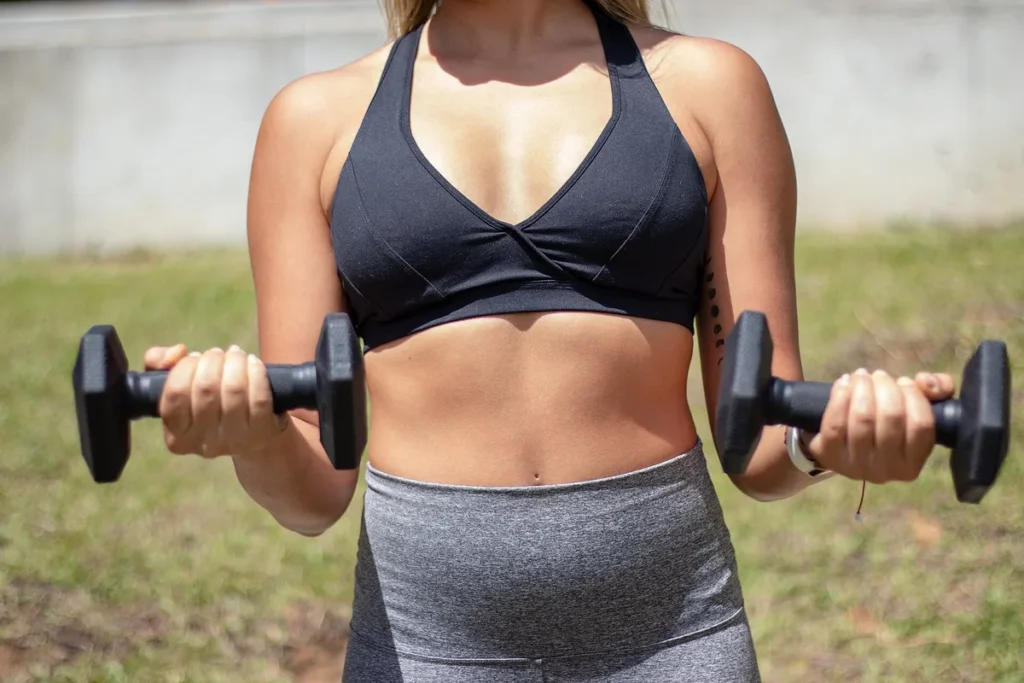
Arm Workouts With Weights: 12 Moves for Stronger Biceps and Triceps
Arm workouts with weights are the fastest reliable way to build bigger, stronger arms. Curls alone will not do it. A good routine trains the biceps and the triceps, adds forearm and grip work, and gives you a clear way to get stronger week after week. The 12 moves below need nothing more than a pair of dumbbells and, for two of them, a barbell. Pick two biceps moves, two triceps moves and one grip move per session, train arms two
or three times a week, and add a little weight or a few reps whenever a set starts to feel easy.
Table of Contents
Why Arm Workouts With Weights Work
Weights let you add resistance in small steps, and that steady progression is what builds muscle. Bodyweight moves are useful, but once you can do 20 push-ups or 15 chin-ups, adding reps stops building much size. A dumbbell lets you add two pounds and keep the challenge exactly where it should be.
There is another reason to train arms with weights. The triceps make up about two thirds of your upper arm, so anyone who only does curls is training the smaller muscle and ignoring the bigger one. A balanced arm workout with weights gives the triceps at least as many sets as the biceps.
Health guidance backs the habit too. The US Centers for Disease Control and Prevention recommends muscle-strengthening activity on two or more days each week, working all major muscle groups, including the arms. The federal Physical Activity Guidelines for Americans say the same, and they note that strength work should be done at moderate or greater effort. Two short arm sessions a week already meet that bar.
The Muscles You Are Training
Knowing the muscles helps you pick the right moves. The biceps sit on the front of the upper arm and bend the elbow. They have two heads, and different curl angles shift the work between them. The triceps sit on the back of the upper arm and straighten the elbow. They have three heads, and the long head only gets fully loaded when your arm is overhead. Under the biceps sits the brachialis, a muscle that pushes the biceps up and makes the arm look thicker from the side. The forearms control your grip, and they get worked every time you hold a heavy dumbbell.
The list below mixes curls, overhead extensions, pressing moves and grip work instead of repeating one curl ten ways.
12 Best Arm Workouts With Weights
Biceps Moves
1. Dumbbell Biceps Curl
Stand tall with a dumbbell in each hand, palms facing forward. Curl the weights up without letting your elbows drift forward, squeeze at the top, then lower slowly for three seconds. Keep your upper arms still and your hips out of it. Do 3 sets of 8 to 12 reps.
2. Hammer Curl
Hold the dumbbells with your palms facing each other, like holding two hammers. Curl up the same way as a regular curl. The neutral grip shifts more work to the brachialis and the forearms, which builds arm thickness. Do 3 sets of 10 to 12 reps.
3. Incline Dumbbell Curl
Set a bench to about 45 degrees and sit back with your arms hanging behind your torso. Curl from that stretched position. The stretch at the bottom is the point of this move, so use a lighter weight than your standing curl and control every rep. Do 3 sets of 10 to 12 reps.
4. Barbell Curl
Grip a barbell shoulder-width apart and curl it up with your elbows pinned to your ribs. The barbell lets you lift more than two dumbbells, which makes it the easiest curl to track and progress over months. Do not swing from the hips to lift the weight. Do 4 sets of 6 to 10 reps.
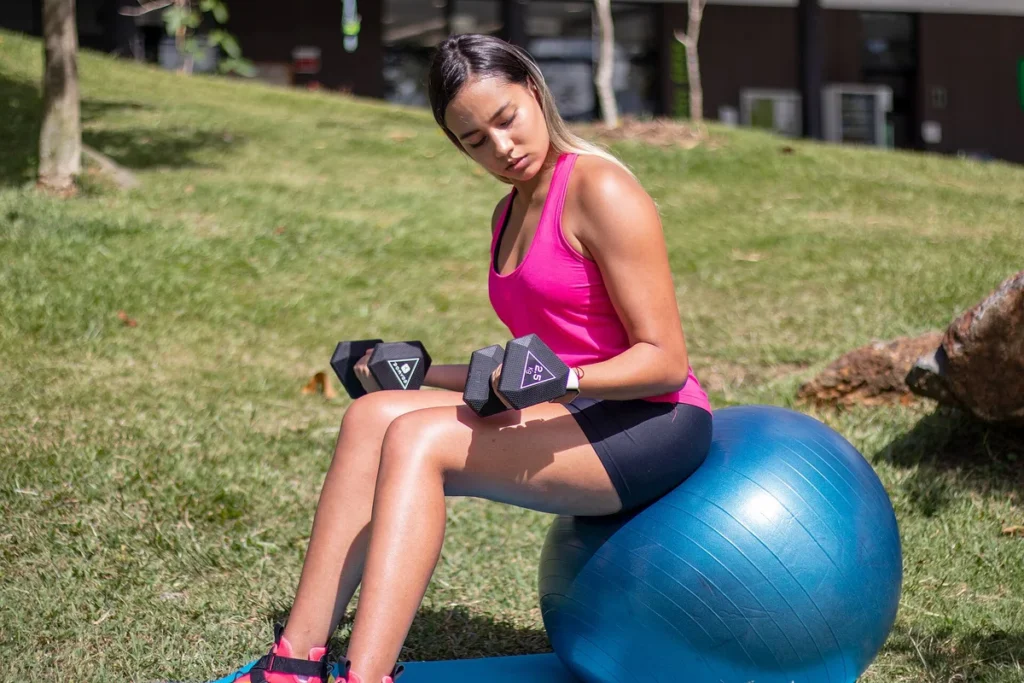
5. Concentration Curl
Sit on a bench, brace one elbow against the inside of your thigh, and curl a single dumbbell with a slow, full range of motion. This is a strict move with no room to cheat, so it is a good finisher after your heavier curls. Do 2 sets of 10 to 15 reps per arm.
Triceps Moves
6. Overhead Dumbbell Triceps Extension
Hold one dumbbell with both hands above your head, elbows pointing forward. Lower the weight behind your head until your forearms are roughly parallel to the floor, then press it back up. The overhead position stretches the long head of the triceps, the part that gives the back of the arm its size. Keep your elbows close and your ribs down. Do 3 sets of 10 to 12 reps.
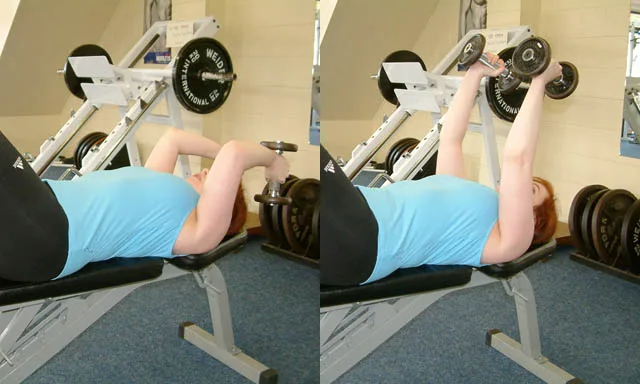
7. Lying Triceps Extension (Skull Crusher)
Lie on a bench holding a dumbbell in each hand above your chest. Bend only at the elbows to lower the weights toward your forehead, then press them back up. Keep your upper arms still and your elbows pointing up, not flaring out. Do 3 sets of 10 to 12 reps.
8. Dumbbell Kickback
Hinge forward with a flat back, one dumbbell in each hand, elbows tucked at your sides. Extend your forearms back until your arms are straight, squeeze for a second, then lower with control. Use a light weight and a full range of motion. Do 2 sets of 12 to 15 reps.
9. Close-Grip Dumbbell Floor Press
Lie on the floor with a dumbbell in each hand, palms facing each other, elbows tucked close to your ribs. Press the weights up until your arms are straight, then lower until your elbows touch the floor. The close grip and the floor stop make this a triceps-first pressing move. Do 3 sets of 8 to 12 reps.
Forearm and Grip Moves
10. Reverse Curl
Hold a barbell or two dumbbells with an overhand grip, palms facing down, and curl. The reversed grip loads the brachioradialis and the forearms hard. Use about half the weight of your normal curl. Do 2 sets of 10 to 15 reps.
11. Dumbbell Wrist Curl
Rest your forearms on a bench with your wrists hanging off the edge, palms up, a light dumbbell in each hand. Curl the weight up with your wrists only, then lower slowly. Small muscles need small weights and full control. Do 2 sets of 12 to 15 reps.
12. Farmer Carry
Pick up the heaviest dumbbells you can hold with a straight back and walk for 20 to 40 seconds. Your grip, forearms and shoulders all work at once. Do 2 to 3 carries.
A Simple Weekly Arm Workout Plan
Train arms two or three times a week, with at least one rest day between sessions. A beginner session of arm workouts with weights takes about 25 minutes. Pair a biceps move with a triceps move and rest 60 to 90 seconds between sets.
| Day | Exercises | Sets x Reps |
|---|---|---|
| Monday | Dumbbell curl, overhead triceps extension, hammer curl, lying triceps extension | 3 x 8-12 each |
| Wednesday | Barbell curl, close-grip floor press, reverse curl, farmer carry | 3 x 8-12, carry 2 x 30 sec |
| Friday | Incline curl, dumbbell kickback, concentration curl, wrist curl | 3 x 10-15 each |
If you already train your back and chest, your arms get extra work from rows, pull-ups and presses. In that case two direct arm sessions a week is plenty. If arms are your weak point, train them first in the workout, while you are fresh, because the exercise you do first gains the most strength.
How to Pick Your Starting Weight
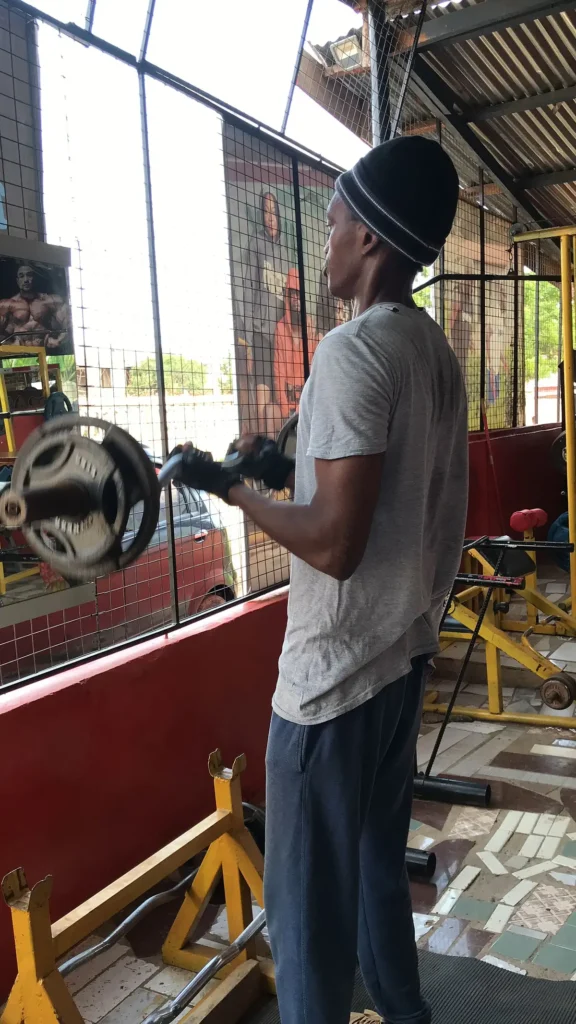
Pick a weight you can lift for 8 to 12 clean reps, where the last two reps feel hard but your form still holds. If you cannot reach 8 reps, the weight is too heavy. If you can do more than 12 with ease, it is too light. For isolation moves like kickbacks and wrist curls, use the 12 to 15 rep range and lighter weights.
Progress is simple. When you hit the top of the rep range on every set, add the smallest weight jump available next session and start again at the bottom of the range. A slower lowering phase also counts: three seconds down makes a light dumbbell feel much heavier. If you are new to lifting, our guide on how to start working out as a complete beginner walks through the first four weeks step by step.
5 Mistakes That Stall Arm Growth
1. Swinging the weight up. Momentum takes the work off the muscle. If your hips move, lower the weight and do the rep properly.
2. Training biceps only. The triceps are the bigger muscle. Give them equal sets or your arms will stay small from the back.
3. Using the same weight for months. Muscle grows when the challenge grows. Track your sets and reps, and add a little weight or a few reps every week or two.
4. Skipping rest. Arms recover in about 48 hours. Training them hard every day just builds soreness, not size.
5. Ignoring pain in the elbow. Sharp elbow pain is a signal to stop, not to push through. Lower the weight, slow down, and see a clinician if the pain lasts more than a week. A short HIIT session on rest days keeps your conditioning up without loading the elbows.
How Often Should You Train Arms?
Two sessions a week is enough for most people to build visible arm size, and three works well if arms are a priority. Each session should include two to four exercises, six to ten total sets, and a rest day before the next arm day. Keep your arm workouts with weights steady for at least eight weeks before changing exercises, because changing moves every week makes progress impossible to track.
Food matters as much as the workout. Muscle needs protein and enough total calories to grow, so a simple meal prep routine that puts protein in every meal makes the training pay off faster. And a strong core supports heavy curls and presses, so finish the week with the best lower ab exercises for balance.
Frequently Asked Questions
How long does it take to build bigger arms with weights?
Most beginners notice firmer, slightly bigger arms in four to six weeks of consistent training, and clear visible growth in eight to twelve weeks. Progress depends on training twice a week, adding weight over time, eating enough protein and sleeping well.
Are dumbbells or barbells better for arm workouts?
Both work. Dumbbells let each arm work alone, which fixes strength gaps between sides. Barbells let you lift more weight and track progress easily. A good arm workout with weights uses both across the week.
Can I train arms every day?
No. Muscles grow while they recover, and arms need about 48 hours between hard sessions. Train them two or three times a week and use the other days for legs, back, chest or rest.
What is the best arm exercise for biceps?
There is no single best move. The dumbbell curl builds the biceps directly, the hammer curl adds thickness through the brachialis, and the incline curl loads the muscle in a stretched position. Use two or three of them together.
Do arm workouts with weights help with weight loss?
They help indirectly. Muscle tissue burns more calories at rest than fat tissue, and strength training protects muscle while you lose fat. For fat loss itself, pair arm training with regular cardio and a sensible diet.
Conclusion
Arm workouts with weights work when they are balanced, progressive and consistent. Train the biceps and the triceps, add forearm and grip work, and give the triceps the attention they deserve, since they are the larger muscle. Pick weights you can control for 8 to 12 reps, add a little load whenever the top of the range gets easy, and train arms two or three times a week with rest between sessions. Follow the plan above for eight weeks and your arms will be measurably stronger and visibly bigger.
