
Pickleball Rules: Complete Beginner’s Guide for 2026
Pickleball rules come down to five ideas: serve underhand and diagonally, let the ball bounce once on each side before anyone volleys, never volley while standing in the 7 foot non-volley zone called the kitchen, score points only when your side is serving, and play to 11 points, win by 2. Everything else in the official rulebook refines those five points. This guide explains the full pickleball rules in plain English, based on the 2026 USA Pickleball Official Rulebook, so you can walk onto a court for the first time and play with confidence, whether your game is singles or doubles.
Table of Contents
The 5 Core Pickleball Rules
Before the details, here are the five rules that run every game:
- The serve is underhand and diagonal. The server hits the ball underhand into the diagonally opposite service box.
- The two-bounce rule. The serve must bounce before the return, and the return must bounce before the serving team plays it. Only after those two bounces can anyone volley.
- The kitchen rule. No player may volley, meaning hit the ball out of the air, while standing in the 7 foot non-volley zone or touching its line.
- Side-out scoring. Only the serving side can score a point. If the receiving side wins the rally, they win the serve, not a point.
- Games go to 11, win by 2. Tournament medal matches may play to 15 or 21, still win by 2.
Learn those five and you know enough to play your first game. The rest of this guide fills in the details that keep casual games friendly and disputes short.
The Court and Equipment
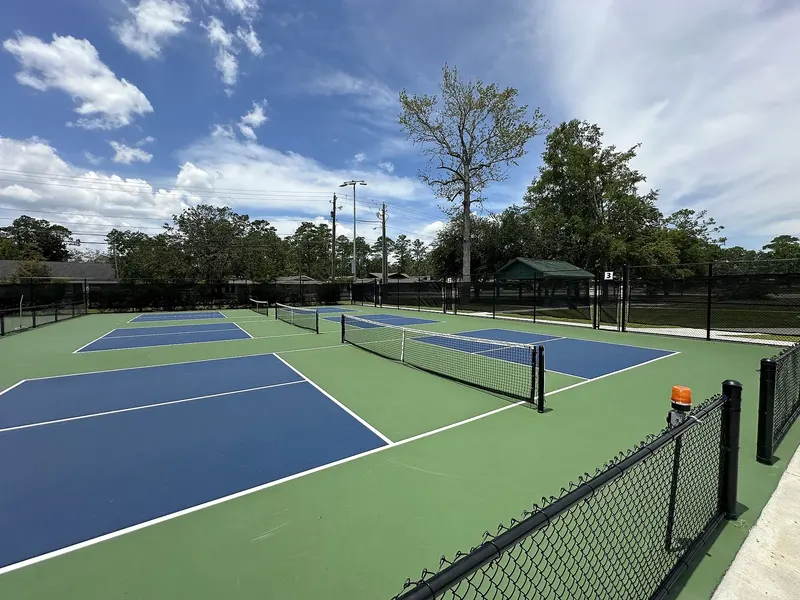
A pickleball court is 20 feet wide by 44 feet long, the same size for singles and doubles, and about a quarter the size of a tennis court. The net stretches the full width of the court, 36 inches high at the sidelines and dipping to 34 inches in the center. Each half of the court has three zones that govern how the game works.
The non-volley zone, the kitchen, is a 7 foot deep zone on each side of the net, stretching the full width of the court. Behind each kitchen are two service courts, split by a centerline. Each service box is 10 feet wide and 15 feet deep. When serving, you aim for the diagonally opposite box.
Equipment is simple. A pickleball paddle is solid, with no strings, and the combined length and width including the edge guard and butt cap cannot exceed 24 inches, with the length no more than 17 inches. The ball is a hollow plastic ball with holes, similar to a wiffle ball, and it comes in indoor and outdoor versions. Outdoor balls have smaller holes and are slightly heavier to handle wind. Wear court shoes with good lateral support: running shoes are built for forward motion and can roll an ankle on the quick side to side moves pickleball demands.
Serving Rules
There are two legal serves in pickleball. The volley serve is the standard one: the ball is released and struck out of the air. It must meet three requirements under the 2026 rulebook, each of which must be met clearly: the paddle swings in an upward arc, the contact point is below the waist, and the paddle head is below the wrist at contact. The server must have at least one foot behind the baseline at contact, between the imaginary extensions of the centerline and the sideline, and the ball may not be spun or manipulated on release.
The drop serve is the alternative. The server drops the ball from the hand or paddle and strikes it after it bounces. The ball must fall by gravity: it cannot be thrown or pushed downward. There are no restrictions on where the ball is dropped from or on the paddle motion afterwards, which makes the drop serve easier for players who struggle with the volley serve rules.
Where the serve must land matters as much as how it is hit. The serve goes diagonally cross court into the opponent’s service box, and it must land past the non-volley zone and all of its lines. A serve that lands on the kitchen line is a fault: the kitchen line is the one line in pickleball that counts as out on a serve. Every other boundary line is in: if any part of the ball touches a line, it is good. There are no let serves. If the ball clips the net and still lands legally in the service court, it is live and play continues.
The Two-Bounce Rule
The two-bounce rule is the rule that confuses beginners most, and it is also the rule that makes pickleball different from tennis. The serve must bounce before it is returned, and the return of serve must bounce before the serving team plays it. Only after those two bounces may either side volley the ball out of the air.
The practical effect is that both teams start each rally at the back of the court. The serving team stays back for the third shot, because they cannot volley the return, and the receiving team is already back to return the serve. The soft third shot drop, a gentle arcing shot that lands in the opponent’s kitchen, is the most important shot in pickleball precisely because it lets the serving team move forward safely after the two bounces are done.
The Kitchen: The Non-Volley Zone
The kitchen is the 7 foot area on both sides of the net, and its rule is simple: you cannot volley the ball while touching the kitchen or its line. That includes anything you are wearing or holding, like your paddle or a hat that falls off. You can stand in the kitchen any time you like, and you can hit the ball from inside it after it bounces. What you cannot do is take the ball out of the air while any part of you is in the zone.
Two details catch new players out. First, your momentum counts: if you volley from outside the kitchen and your momentum carries you into it, that is a fault. Second, the rule applies to the line itself: touching the kitchen line while volleying is a fault, even if your feet are otherwise outside the zone. The kitchen is also the most strategically important area in pickleball. The soft dink shot, which arcs gently into the opponent’s kitchen and forces a soft reply, is the shot that wins most points at higher levels.
Scoring: How Points Work
In standard side-out scoring, only the serving team can score. If the receiving team wins the rally, they earn the serve, which is called a side-out, but no point is scored. Games normally go to 11 points, win by 2. Tournament medal matches often use 15 or 21, still win by 2.
In doubles, the server calls three numbers before every serve: the serving team’s score, then the receiving team’s score, then the server number, 1 or 2. Each team has two servers per turn, except at the very start of the game, when the team that serves first gets only one server, so the opening server counts as server 2 and the game starts at 0-0-2. The server has 10 seconds after calling the score to serve, and the full score must be called before every serve.
Rally scoring is an official provisional option under the 2026 rules. In rally scoring, every rally wins a point for somebody, each team has just one server per turn, and the score is called as two numbers. Under the 2026 rule change, a receiving team on game point can now win the game by winning the rally. Local leagues frequently adopt variations, rally scoring, games to 15, or relaxed kitchen enforcement, and that is entirely normal for social play. For sanctioned tournament play, the official rulebook is always the authority, and USA Pickleball publishes the current official rules on its site.
Doubles vs Singles
Doubles is the game most people play. Two players per side, the three number score call, and service that rotates between both partners. Positioning matters more than power: the team that controls the kitchen line usually controls the rally, and the best doubles teams move together, side to side, like they are tied by a rope.
Singles uses the same court, the same net, and the full court width. The score is called as two numbers, server’s score then receiver’s score, and there is just one server per turn. Singles is far more physical than doubles, because one player covers the whole court. It is a genuine workout, and building a base of fitness helps: our 8 week beginner plan in how to train for your first 5K builds the same endurance and leg strength that singles pickleball demands. Core strength matters too, and the moves in our best lower ab exercises guide support the quick twisting and reaching the game requires.
Common Faults
A fault is any infraction that ends the rally. The most common ones are:
- A serve that lands in the non-volley zone or on its line, or outside the correct service court.
- A serve that hits the net and lands in the kitchen or out of bounds.
- Volleys before the two bounces are complete.
- Volleying while touching the kitchen or its line, including by momentum or by anything you are wearing.
- Hitting the ball out of bounds or into the net.
- A ball that hits a player, their clothing, or anything they are wearing.
- Calling the wrong score and serving before the error is corrected, or taking more than 10 seconds to serve after the score is called.
When a fault is committed by the serving side, the serve passes to the other side or to the partner. When a fault is committed by the receiving side, the serving side scores a point. If you are unsure whether a ball was in or out, the etiquette is to replay the point rather than argue: in social play, a replay costs nothing and keeps the game friendly.
Frequently Asked Questions
What are the 5 main rules of pickleball?
Serve underhand and diagonally, let the ball bounce once on each side before volleying, do not volley from the non-volley zone, score only on your serve, and play to 11 points, win by 2.
Can you step in the kitchen in pickleball?
Yes. You can stand in the kitchen any time. What you cannot do is hit the ball out of the air while touching the kitchen or its line. You can hit the ball from the kitchen after it bounces.
How do you score in pickleball?
Only the serving side scores. Games go to 11, win by 2. In doubles, the score is called as three numbers: serving team score, receiving team score, server number. In singles, it is two numbers.
What is the two-bounce rule in pickleball?
The serve must bounce before it is returned, and the return of serve must bounce before the serving team plays it. Only after both bounces can either side volley the ball.
Conclusion
Pickleball rules are simpler than they first look. Serve underhand and diagonally, respect the two-bounce rule, stay out of the kitchen when you volley, remember that only the serving side scores, and play to 11, win by 2. That is enough to enjoy your first game, and the finer points, the drop serve, rally scoring, and doubles rotation, will make sense after a few matches. Bring court shoes, call the score clearly, and when a line call is close, replay the point. The game rewards patience and placement far more than power, which is exactly why so many people fall for it.
