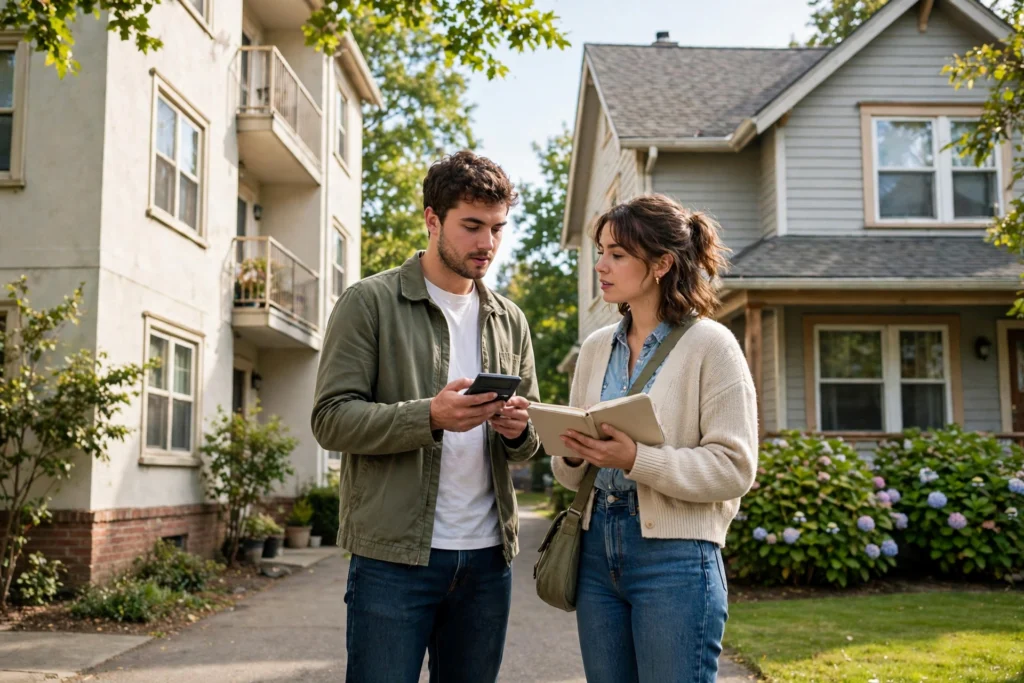
Renting vs Buying a Home: An Honest Pros and Cons List
“Renting is throwing money away” might be the most expensive sentence in personal finance. It has pushed thousands of people into houses they sold two years later at a loss, while their renting friends quietly invested the difference. Renting vs buying a home is not a test of adulthood. It is a math problem with a lifestyle wrapper, and the right answer depends mainly on one variable: how long you will stay.
This guide lays out the real costs on both sides, including the ones each side hides, the break even logic lenders use, and the five questions that settle the decision for your situation.
Table of Contents
The Real Costs of Buying (Beyond the Mortgage)
A mortgage payment is only the visible part of owning. The full monthly cost of a bought home includes:
- Mortgage principal and interest: with rates around the low sixes in recent months, interest dominates early payments
- Property taxes: commonly 1 to 2 percent of the home’s value every year, paid monthly through escrow
- Homeowners insurance: averaging roughly 3,500 dollars a year nationally in recent industry figures, and rising fast in storm and fire zones
- Maintenance and repairs: budget about 1 percent of the home’s value per year; roofs, furnaces, and water heaters do not care about your plans
- HOA fees where they apply: a median around 135 dollars a month in communities that have them
- Buying and selling costs: closing costs of roughly 2 to 5 percent going in, and agent and seller costs of a similar scale coming out
That round trip of transaction costs is why buying for a short stay loses money even when prices rise modestly.
The Real Costs of Renting (Beyond the Rent)
In any renting vs buying a home comparison, the renting side looks simpler, and mostly is, but it has its own ledger:
- Rent itself: one predictable payment, but one that can rise at every renewal
- Renters insurance: only about 150 dollars a year on average, a genuine bargain
- No maintenance bills: the landlord owns the broken water heater problem
- Moving flexibility: leaving costs a lease break at worst, not a six month sale process
- The hidden risk: no equity builds, the home can be sold out from under you, and long term rent growth compounds quietly for decades
Renting vs Buying a Home at a Glance
| Factor | Renting | Buying |
|---|---|---|
| Upfront cash needed | Deposit plus first month | Down payment plus 2 to 5 percent closing costs |
| Monthly cost pattern | Rent, usually rising yearly | Fixed mortgage, plus taxes and insurance that rise |
| Builds wealth | Only if you invest the savings | Equity from payments plus possible appreciation |
| Maintenance | Landlord’s problem | Entirely yours |
| Freedom to move | High | Low in the first years |
| Freedom to customize | Limited | Full |
| Main risk | Rent inflation, forced moves | Price falls, expensive repairs, being stuck |
The Five Year Rule, and Why It Works
In the renting vs buying a home debate, financial planners repeat a simple rule: buying usually wins if you stay at least five years, and renting usually wins below that. The math behind it is the transaction round trip. Buying and later selling a home can easily consume 7 to 10 percent of its value in combined costs. Spread over two years, that overwhelms any equity you built. Spread over seven, normal appreciation and principal payments usually overtake it comfortably.
Worked example, kept deliberately simple: a 400,000 dollar home bought with 10 percent down carries about 12,000 dollars of closing costs going in. Selling three years later might cost roughly 30,000 dollars in commissions and seller expenses. Your payments in those three years built only modest equity because early payments are mostly interest. Unless the home gained serious value, the renter who invested the down payment often finishes ahead. That is the renting vs buying a home math in one paragraph. Extend the stay to seven years and the picture normally flips. The Consumer Financial Protection Bureau’s homebuying guidance walks through these ownership costs in official detail, and it is worth reading before signing anything.
Five Questions That Settle It for You
- How long will I honestly stay? Count job changes, family plans, and restlessness honestly. Under five years points strongly to renting.
- What does the same home cost to rent? If renting the equivalent home costs far less per month than owning it, the market is telling you something. Listen.
- Will I invest the difference if I rent? Renting wins mathematically when the saved down payment and monthly difference get invested, not spent. Be honest about which person you are.
- Can I absorb a 10,000 dollar repair in year one? If a new roof would break you, you are not ready to own, whatever the bank approved.
- Do I want the work? Owning is a part time job of maintenance and decisions. Some people love it. Wanting it is a legitimate reason to buy; dreading it is a legitimate reason to rent.
If buying wins your answers, our step by step guide on how to buy your first home in the US takes you from pre approval to keys. If you are weighing the decision at the other end of life, downsizing and renting appear again in our ranking of the best places to retire in the US, where several top towns work beautifully as rentals first.
Frequently Asked Questions
Is renting really throwing money away?
No. Rent buys housing, flexibility, and freedom from repair bills, exactly as a mortgage payment buys housing plus a growing ownership share. Buying also “throws away” money on interest, taxes, and insurance, especially in the early years. The honest comparison is total cost over your actual stay, not slogans.
How much cheaper is renting than buying right now?
In many US metros in 2025 and 2026, renting a comparable home has cost noticeably less per month than buying it, because prices and mortgage rates are both high. The gap varies city by city, which is why the same home rent comparison in question two matters more than national averages.
What credit score and down payment do I need to buy?
Conventional loans typically want a score in the mid 600s or higher and at least 3 to 5 percent down, with 20 percent avoiding private mortgage insurance. FHA loans allow lower scores and 3.5 percent down. Bigger is not automatically better: keeping an emergency fund after closing matters more than hitting a round number.
Can renting ever build more wealth than buying?
Yes, when the stay is short, local prices are extreme relative to rents, or the renter genuinely invests the difference over a long period. Ownership wins by default because the mortgage forces saving; renting wins only with discipline, which is why honest self knowledge is part of the math.
Final Word
Renting vs buying a home has a correct answer, but it is your answer, computed from your timeline, your market, and your habits. Run the five year test, price the real costs on both sides, and let the numbers, not the slogans, choose your next front door.