How to Be More Productive Working From Home (Without Burning Out)
Working from home sounds like a productivity cheat code. No commute, no dress code, your own coffee. Then the day actually starts, and somehow you’re answering emails from the couch at 10 a.m., half-watching a video, laundry in the washer, and a vague feeling that you’ve been “busy” for three hours without finishing anything. If you want to learn how to be more productive working from home, it’s rarely about working harder. It’s about giving a formless day some shape.
Table of Contents
The office gave you structure for free: a place, a start time, people who could see whether you were working. At home, you have to build that structure yourself. The good news is that your version can be kinder than the office’s ever was.
Productive at home means finished, not busy
Start by redefining the target. A productive day at home is not ten hours of visible effort. It’s a day where the two or three things that actually mattered got done, and the rest was handled well enough. Most people who feel unproductive at home aren’t lazy. They’re drowning in small tasks, messages, and half-started projects.
So judge the day by finished things. One completed report beats nine started ones. You stop asking “what should I do today?” and start asking “what needs to be true by 5 p.m.?”
Give your brain a place that means work
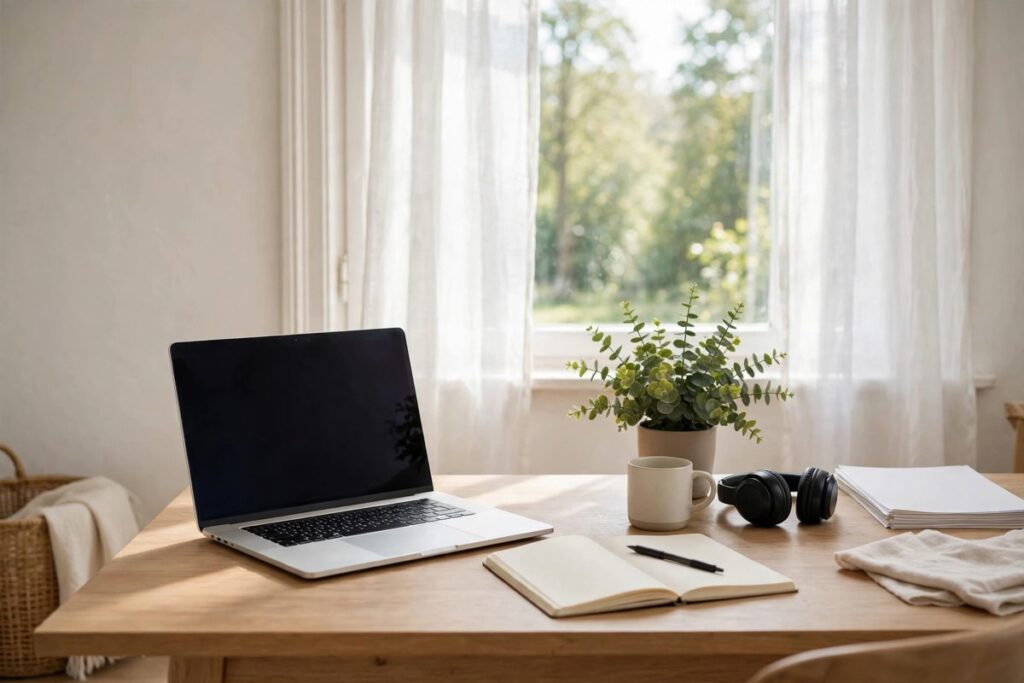
You don’t need a spare room with a door. You need one spot that your brain learns to associate with working, and it can be a specific chair at the kitchen table if that’s what you’ve got. When you sit there, you work. When you’re on the couch, you don’t. Brains run on associations, and a consistent spot builds one surprisingly fast.
Set the spot up properly once. A chair that doesn’t punish your back, a second screen if your work needs one, chargers that live there permanently. Every minute spent hunting for a cable is a small tax on starting.
And defend the boundary politely but firmly. Family, roommates, partners: people at home tend to read “home” as “available.” A closed door, headphones on, or even a set phrase like “I’m in work mode until lunch” saves everyone the friction of guessing.
How to be more productive working from home: build a day with edges
The single biggest difference between people who thrive at home and people who drift is whether the day has edges. A start ritual and a shutdown ritual, with a rough plan in between.
The start ritual can be tiny: coffee, a shower, a short walk around the block that pretends to be a commute. What matters is that something marks “now we’re working.” The plan matters even more. Before the inbox gets a vote, write down your two or three priorities for the day on paper. Then give the first one the first real block of your morning, ideally ninety minutes where messages wait. Deep work first; the day will fill itself with other people’s priorities otherwise.
Time blocking sounds rigid, but a light version works: mornings for focused work, a cluster of meetings midday, admin and messages in a batch late afternoon. The point isn’t a perfect calendar. It’s that tasks get a home instead of ambushing you all day.
The shutdown ritual is the one people skip, and it’s the one that prevents burnout. At a set time, review what got done, jot tomorrow’s first task, close the tabs, and shut the laptop like you mean it. Work you never visibly finish will follow you around the house all evening.
Meetings, messages, and the notification problem
Remote work quietly replaced hallway chats with a constant drip of notifications, and the drip is exhausting. Every ping is a tiny context switch, and context switches are where focus goes to die.
Batch the small stuff. Most messages can wait an hour; almost none get better by being answered in forty seconds. Check chat and email at set times rather than living inside them, and tell your team so. For meetings, ask the quiet question: could this be a message? If it truly needs a call, a shorter one with a clear purpose beats an hour of gentle drift.
If your role allows it, keep one stretch of the day genuinely unreachable. It’s amazing how much of the “urgent” stuff solves itself, or turns out to be not very urgent, by the time you resurface.
The energy stuff nobody puts in productivity guides
Productivity advice loves apps and ignores bodies. Daylight matters: work near a window if you can, and get outside at least once a day. Movement in general is the remote worker’s missing ingredient. The office smuggled it in, hallway walks, stairs, the trip to lunch. At home, you have to schedule what used to happen by accident.
Breaks are part of this, not a reward for finishing. Stepping away for five or ten minutes every hour or so keeps your focus usable for the whole day instead of spectacular for two hours and useless by three. And eat lunch like a person, away from the keyboard if you can.
How to be more productive working from home on the days you just can’t
Some days the system fails. The house is loud, the work is dull, your brain is soup. Shrink the target instead of abandoning it. Pick the one smallest meaningful thing and do only that. Momentum usually sneaks back in through the side door once something, anything, is finished.
It also helps to change one variable rather than berating yourself: move to a different room, work standing up, put on music you’d never play in an office, or take the laptop to a café for two hours. One drifting day means nothing. A month of them means the system needs adjusting, not that you do.
FAQs
What is the biggest productivity mistake people make working from home?
Letting the inbox set the day’s agenda. If your first hour goes to other people’s requests, your own priorities get whatever energy is left. Decide your two or three key tasks before you open email, and give the first one a protected block of time.
How many hours a day should I actually work from home?
Roughly the hours you’d work in an office, minus the commute, is a sane target. Many people find their real focused output is four to six solid hours; the rest is meetings, messages, and small tasks. Chasing ten “on” hours mostly buys exhaustion.
How do I stop getting distracted by things at home?
Give distractions a time instead of a fight. A quick chore break between work blocks is fine; drifting into a full kitchen clean mid-morning is not. A to-do list, written down so your brain can stop rehearsing it, helps more than willpower.
How do I switch off after work when my office is my home?
Use a shutdown ritual: review the day, write tomorrow’s first task, close everything, and physically put work out of sight if you can. The ritual tells your brain the day is over, which is what the commute used to do for free.